Sunday, February 25, 2024

Carlo Bonavia - Fire in the island, 1758


Carlo Bonavia - Fire in the island, 1758
oil on canvas, 129,1 cm (50 ¾ in.) x 208 cm (81 7/8 in.)
Galerie Perrin

Wrongly identified by Florence Ingersoll-Smouse, in her monograph on Joseph Vernet, as a lost work by that artist, this striking painting is in fact by the Italian painter Carlo Bonavia, as confirmed not only by the blue-toned palette he typically used, but also by the signature which can be seen on a trunk carried by two figures at the bottom centre. The painting, a magnificent nocturne, is unquestionably one of Bonavia’s masterpieces, with a breadth and an ambition that is unprecedented in his corpus. Contrasting the cold light of the moon on one side with the fire licking at the clouds and colouring them red on the other, it is a perfect illustration of his generation’s taste for the sublime as an aesthetic category. 

Carlo Bonavia remains a little-known figure among the great Italian landscape painters of the eighteenth century. Probably born in Rome, he is known to have been mostly active from the middle of the 1750s in Naples, where he remained until his death in 1788. Influenced initially by Salvator Rosa (1615-1673), he owed most of his inspiration to Vernet (1714-1789), which has incidentally led to many cases of confusion about attribution. Just like the French landscape painter, Bonavia succeeded in developing an international clientele of foreign aristocrats on the Grand Tour, such as Lord Brudenell and Count Karl Joseph Firmian (1716-1782), who was Austria’s ambassador to Naples from 1753 to 1758 and who owned no less than seventeen of Bonavia’s paintings. 

Although the signature is partly difficult to read, it is interesting to note that next to the date 1758, the painter has added the letters ‘RA’, perhaps to signify Rome. Does this confirm his Roman origins? Or did Bonavia return temporarily to the Eternal City to execute this large painting, whose ambition and size suggest a commission from an important patron? Dated 1758, the present painting is the same size as the large Storm off a Rocky Coast sold at Sotheby’s London on 3 July 1996 (lot 51). This work is dated 1757, and it would be reasonable to speculate, given their similarities and complementary character, that the present work may have been painted as a pendant to the first.
Saturday, January 6, 2024

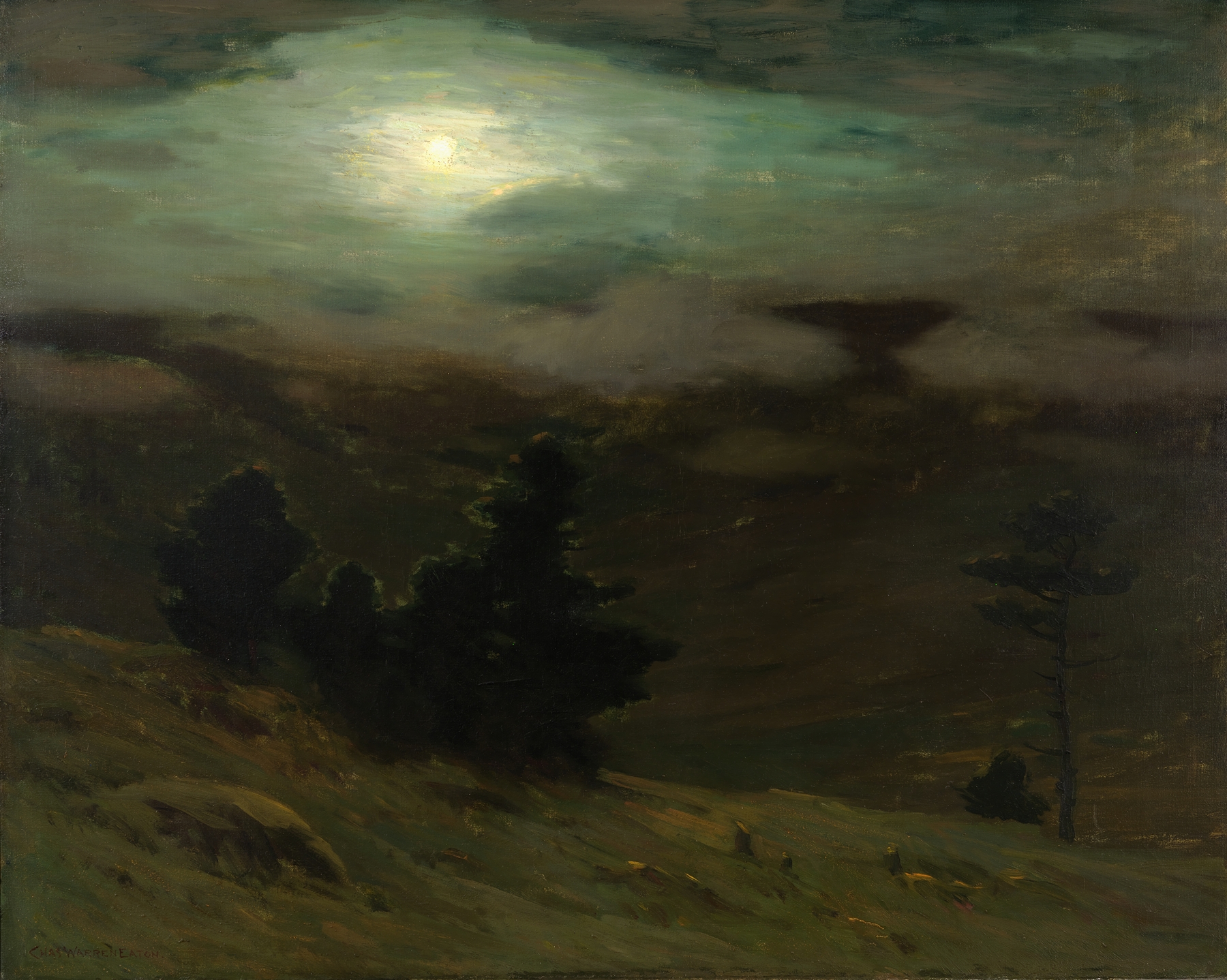
Charles Warren Eaton - Gathering Mists, 1905


Charles Warren Eaton - Gathering Mists, 1905
oil on canvas, 91.4 cm (35.9 in) x 114.2 cm (44.9 in)
Smithsonian American Art Museum

Carl Locher - Fishing cutters in the moonlit night, 1888


Carl Locher - Fishing cutters in the moonlit night, 1888
oil on canvas, 35 cm (13.7 in) x 45.5 cm (17.9 in)
Skagens Museum

Stefan Popowski - Pines,1900


Stefan Popowski - Pines,1900

John Atkinson Grimshaw (English, 1836 -1893) - Figures In A Moonlit Lane After Rain


John Atkinson Grimshaw (English, 1836 -1893) - Figures In A Moonlit Lane After Rain 
oil on canvas, 58.5 x 91.5 cm. (23 x 36 in.)

Giovanni Battista Innocenzo Colombo (Swiss, 1717-1793) - Figures by an encampment in a nocturnal landscape


Giovanni Battista Innocenzo Colombo (Swiss, 1717-1793) - Figures by an encampment in a nocturnal landscape 
oil on canvas, 82 × 93 cm (32.2 × 36.6 in)
Private collection

George Roux - Night party at the 1889 Universal Exhibition, under the Eiffel Tower (Fête de nuit à l’Exposition universelle de 1889, sous la tour Eiffel), 1889


George Roux - Night party at the 1889 Universal Exhibition, under the Eiffel Tower (Fête de nuit à l’Exposition universelle de 1889, sous la tour Eiffel), 1889
oil on canvas, 65 cm (25.5 in) x 95 cm (37.4 in)
Musée Carnavalet

Moritz von Schwind - Farewell at Dawn, 1859


Moritz von Schwind - Farewell at Dawn, 1859
oil on cardboard, 24.0 x 36.0 cm
Alte Nationalgalerie, Staatliche Museen zu Berlin

In works — both poetic and accessible — which the artist himself referred to as “occasional poems,” Schwind liked to record episodes from his own life. He also described this series of small idylls as “Travel Pictures.” Scenes, like this one of his departure from Vienna thirty years before, are concentrated into a lyrical image. Here, the painting achieves its timeless relevance by the telling way it captures that decisive moment of the traveller looking back and forwards at the same time. via

Carolus Tremerie (1858-1945) - Evening Peace


Carolus Tremerie (1858-1945) - Evening Peace 

Lieven Herremans (Belgian, 1858-1921) - Evening at the Ostend Harbour

Lieven Herremans (Belgian, 1858-1921) - Evening at the Ostend Harbour